 ← Research← Research
Published Research · Scientific Data 2024
A realistic quantum-mechanical dataset designed to bring molecular machine learning closer to drug-relevant chemical space. QM40 contains DFT-level properties, optimized geometries and quantitative bond-strength information for 162,954 molecules.
WHY QM40
QM40 was developed to address a key limitation of widely used molecular ML datasets: the gap between small benchmark molecules and the larger chemical structures encountered in drug discovery. The dataset extends to molecules with up to 40 heavy atoms and includes C, N, O, S, F and Cl.
The 162,954 molecules originate from ZINC and were calculated consistently at the B3LYP/6-31G(2df,p) level, matching the level used for QM9 and enabling the datasets to be combined for broader machine-learning studies.
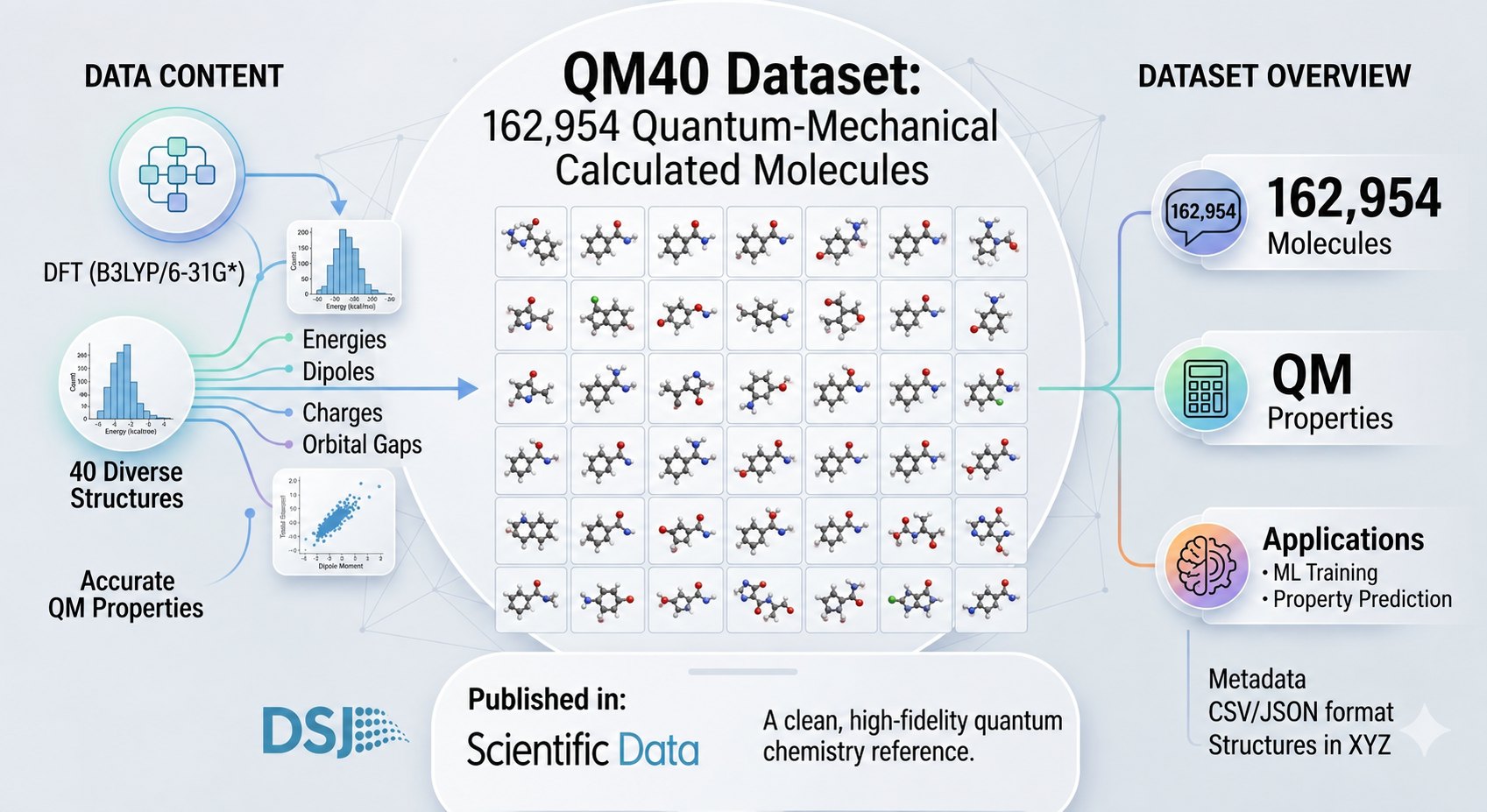
Scientific figure from the published QM40 study: generation and validation of quantum-mechanical molecular data.
DATA CONTENT
Electronic and thermochemical properties include HOMO, LUMO, HOMO–LUMO gap, polarizability, spatial extent, dipole moment, zero-point energy, rotational constants, internal energies, enthalpy, free energy, heat capacity and entropy.
Initial and DFT-optimized Cartesian coordinates are supplied together with atomic identities and Mulliken charges, providing geometry-level information for molecular ML.
Every bond is accompanied by a local vibrational mode stretching force constant, ka, providing a quantitative bond-strength descriptor beyond conventional molecular-property datasets.
SCIENTIFIC VALIDATION
All 162,954 retained molecules were modeled at B3LYP/6-31G(2df,p). Structures with convergence failures or imaginary frequencies were excluded.
LModeA connectivity checks were used to detect optimized structures inconsistent with the original molecular connectivity; structures with unphysical parameters were removed.
Analysis of FDA-approved drugs showed that molecules up to 40 heavy atoms encompass 88% of the analyzed drug chemical space, compared with only about 10% captured by the smaller QM9 size regime.
DATA AT SCALE
The published bond analysis contains 7,760,216 bonds. The most numerous categories include 3,527,093 C–H bonds, 2,114,772 C–C bonds and 1,086,262 C–N bonds.
The validation also found the largest maximum local-mode force constants among N≡N, C≡N and C≡C bond classes, consistent with their known strong-bond character.
| Bond class | Bonds | Average ka |
|---|---|---|
| C–H | 3,527,093 | 5.213 |
| C–C | 2,114,772 | 4.832 |
| C–N | 1,086,262 | 5.527 |
| C–O | 509,494 | 7.384 |
| N–H | 167,258 | 7.090 |
PUBLICATION & DATA
QM40 was published in Scientific Data as “QM40, Realistic Quantum Mechanical Dataset for Machine Learning in Molecular Science” by Ayesh Madushanka, Renaldo T. Moura Jr and Elfi Kraka.