 ← Research← Research
Published Research · Journal of Chemical Information and Modeling 2024
An AI–QM empowered, explainable virtual-screening platform integrating deep learning, ADMET analysis, de novo pharmacophore modeling, quantum mechanics, molecular docking and explainable AI in a modular Python framework.
INTEGRATED DISCOVERY
SmartCADD was developed as an open-source virtual-screening framework in which individual filters can operate independently or be assembled into a sequential discovery pipeline. The published platform combines deep-learning screening with classical CADD and quantum-informed analysis.
Its HIV case study tested three therapeutic classes—nucleoside reverse transcriptase inhibitors (NRTIs), non-nucleoside reverse transcriptase inhibitors (NNRTIs), and protease inhibitors (PIs)—to demonstrate the platform from large-scale screening through lead prioritization.
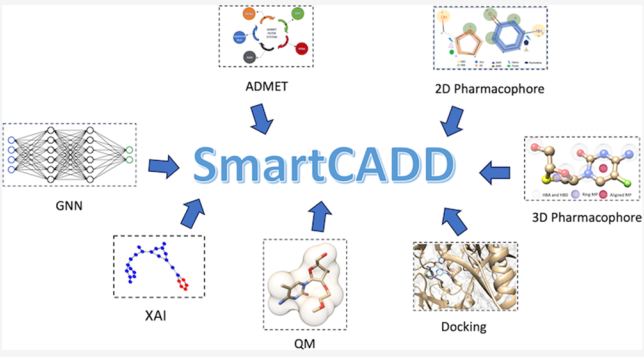
Scientific workflow from the published SmartCADD study.
PUBLISHED PIPELINE
AI PERFORMANCE
| Model | ROC-AUC |
|---|---|
| Attentive FP | 83.34% |
| GCN | 81.40% |
| PAGTN | 80.18% |
| GAT | 77.35% |
The HIV dataset was balanced to 1,443 active and 1,443 inactive compounds per class. Attentive FP produced the highest reported ROC-AUC and was selected for the large-scale ZINC screen.
The deep-learning stage prioritized the top 10 million predicted HIV-active compounds. ADMET filtering then removed 409,997 compounds (4.10%) before pharmacophore analysis.
HIV CASE STUDY
The 2D pharmacophore stage identified these three lead populations. The study then applied QM-optimized 3D analysis, generating nine structural/scoring parameters and examining 100 conformations per molecule to account for molecular flexibility. The top compounds were subsequently evaluated using docking and structural analysis.
EXPLAINABLE AI
SmartCADD wrapped the SubgraphX algorithm to identify molecular subgraphs important to the deep-learning model’s predictions.
In the published analysis, aromatic rings emerged as key functional groups associated with predicted activity for NNRTIs and PIs.
For NRTIs, heterocyclic rings emerged as the critical structural factor in the reported explainability analysis.
3D & DOCKING EVIDENCE
The 3D analysis combined alignment score, shape Tanimoto distance, shape protrude distance, docking score and pharmacophore-distance scores. For the NRTI analysis, 1,452 compounds × 100 conformations were evaluated; the published top-20 set was ranked using alignment score and compared with docking to HIV reverse transcriptase (PDB 6WPJ).
For the leading NRTI example, SMU_NRTIs_1, the reported conformation had an alignment score of 157.34 and docking score of −6.79, compared with −6.68 for the emtricitabine reference in the paper.
PUBLICATION
Published in the Journal of Chemical Information and Modeling by Ayesh Madushanka, Eli Laird, Corey Clark and Elfi Kraka. The paper reports the platform architecture, individual screening modules and the HIV NRTI/NNRTI/PI case study.